Trust Follows This
Amar Pandit
A respected entrepreneur with 25+ years of Experience, Amar Pandit is the Founder of several companies that are making a Happy difference in the lives of people. He is currently the Founder of Happyness Factory, a world-class online investment & goal-based financial planning platform through which he aims to help every Indian family save and invest wisely. He is very passionate about spreading financial literacy and is the author of 4 bestselling books (+ 2 more to release in 2020), 8 Sketch Books, Board Game and 700 + columns.
March 13, 2026 | 2 Minute Read
Most financial professionals spend a lot of time thinking about one question.
“How do I earn my client’s trust?”
It sounds like the right question.
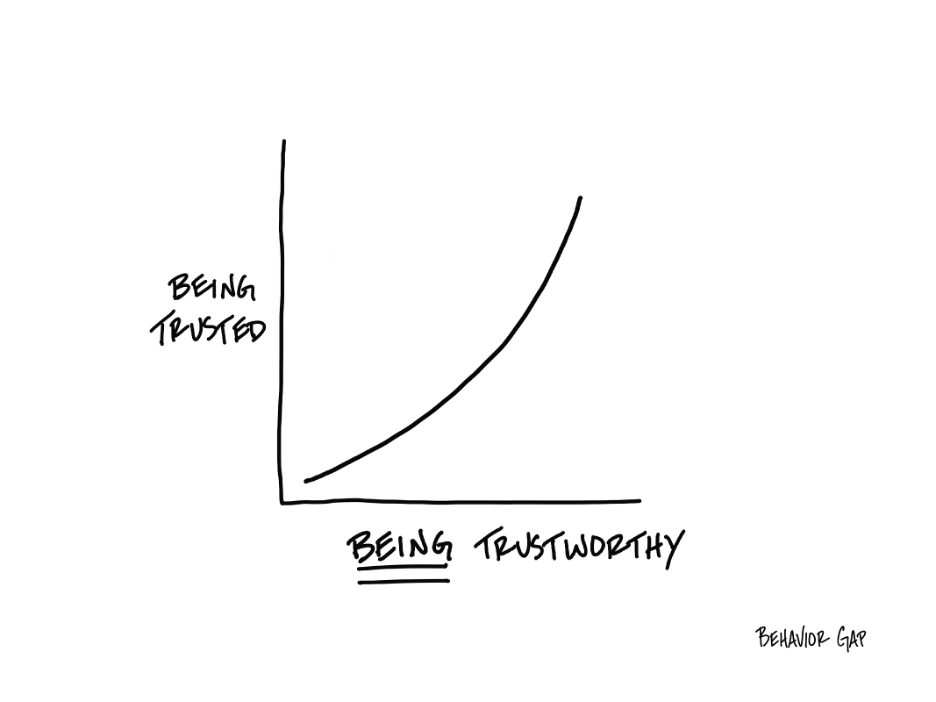
But if you look closely at the sketch above, the answer becomes surprisingly simple.
Trust is not built by trying to be trusted.
Trust is built by being trustworthy.
There is a difference.
A very big difference.
Trying to be trusted often leads to behavior that looks impressive on the surface but does not last.
It shows up as constant promises.
Promises of higher returns.
Promises of market insight.
Promises of access to “special opportunities.”
Promises that the advisor somehow knows what will happen next.
For a short while, this may create the appearance of confidence.
But over time, clients begin to see through it.
Because markets are unpredictable.
No one consistently knows what will happen next.
And when those promises fail, trust erodes very quickly.
Being trustworthy works very differently.
It does not rely on predictions.
It relies on character and consistency.
A trustworthy financial professional tells the truth even when it is uncomfortable.
They explain risk clearly.
They admit what they do not know.
They guide clients through uncertainty instead of pretending certainty exists.
They protect clients from unnecessary complexity.
They focus on long-term outcomes rather than short-term excitement.
And most importantly, they place the client’s interest ahead of their own.
Over time something powerful happens.
Clients begin to notice.
Not immediately.
Trust rarely appears overnight.
But slowly, steadily, the relationship deepens.
Clients start to rely on your judgment.
They listen when markets are volatile.
They stay calm when others panic.
They refer friends and family.
Because they know something simple but powerful.
You are not trying to impress them.
You are trying to protect them.
And that is the real lesson in this sketch.
If you want to be trusted more, spend less time thinking about trust.
Spend more time thinking about how to be worthy of it.
Because when trustworthiness compounds, trust eventually follows.
Similar Post
Nano Learning
Gradually, then Suddenly
In Ernest Hemingway’s novel, “The Sun Also Rises”, a character by the name Mike is asked about his bankruptcy. Mike responds, “Two ways.” He then continues, “Gradually, ....
Read More
28 July, 2023 | 2 Minute Read
Nano Learning
The Impact
Do you know the impact of your work on the lives of your clients?
It’s far more powerful than what you might be thinking or not thinking.
Joy Lere, a clinical psychologist, w ....
Read More
31 March, 2023 | 2 Minute Read
Nano Learning
You Are Not Alone
In the book When Things Don’t Go Your Way, author Haemin Sunim captures a profound truth: “Nothing in this world exists as separate and alone, but that all things rely on each ....
Read More
18 October, 2024 | 2 Minute Read
Nano Learning
The Cheque Book and Calendar
Carl Richards says, “The cheque book and the calendar never lie.” This is a pretty insightful line as it has an application in every aspect of our life.
He says do not tell me ....
Read More
3 September, 2021 | 2 Minute Read
Nano Learning
Become a World Class Editor
Scientific American recently had a post with this headline “Our Brain overlooks this Brilliant Problem-Solving Strategy”.
One of the key points of the post was “People of ....
Read More
23 April, 2021 | 3 Minute Read
Nano Learning
The 3 Types of People you are surrounded with
All of us will be surrounded with 3 types of people.
1. People who we can learn from:
I cannot state how important these people are for your personal and professional growth. The ....
Read More
10 July, 2020 | 1 Minute Read


- 0
- 0
0 Comments