Get This Balance Right

Amar Pandit
A respected entrepreneur with 25+ years of Experience, Amar Pandit is the Founder of several companies that are making a Happy difference in the lives of people. He is currently the Founder of Happyness Factory, a world-class online investment & goal-based financial planning platform through which he aims to help every Indian family save and invest wisely. He is very passionate about spreading financial literacy and is the author of 4 bestselling books (+ 2 more to release in 2020), 8 Sketch Books, Board Game and 700 + columns.
March 27, 2026 | 2 Minute Read

Most wealth professionals believe their job is to present the right facts.
Better data.
Better charts.
Better numbers.
Better projections.
And to be fair, facts and figures do matter. Clients expect clarity. They expect
analysis. They expect you to understand markets, products, and financial planning.
But if your work was only about facts, the internet would have replaced you long ago.
Because facts today are everywhere.
Clients can look up returns in seconds.
They can compare funds instantly.
They can read market opinions all day long.
Yet despite having access to all this information, people continue to seek advice.
Why?
Because financial decisions are rarely made in a purely logical state of mind.
They are made when people are anxious.
When markets are falling.
When a business is struggling.
When a family is worried about the future.
When someone asks quietly, “Will I be okay?”
In those moments, numbers alone are not enough.
This is where empathy enters the picture.
Empathy allows you to understand what your client is feeling, not just what their portfolio is doing.
It helps you listen more carefully.
It helps you notice what is not being said.
It helps you guide someone through uncertainty rather than simply presenting another spreadsheet.
But empathy without facts can also be dangerous.
Reassuring someone emotionally while ignoring financial realities does not help them either.
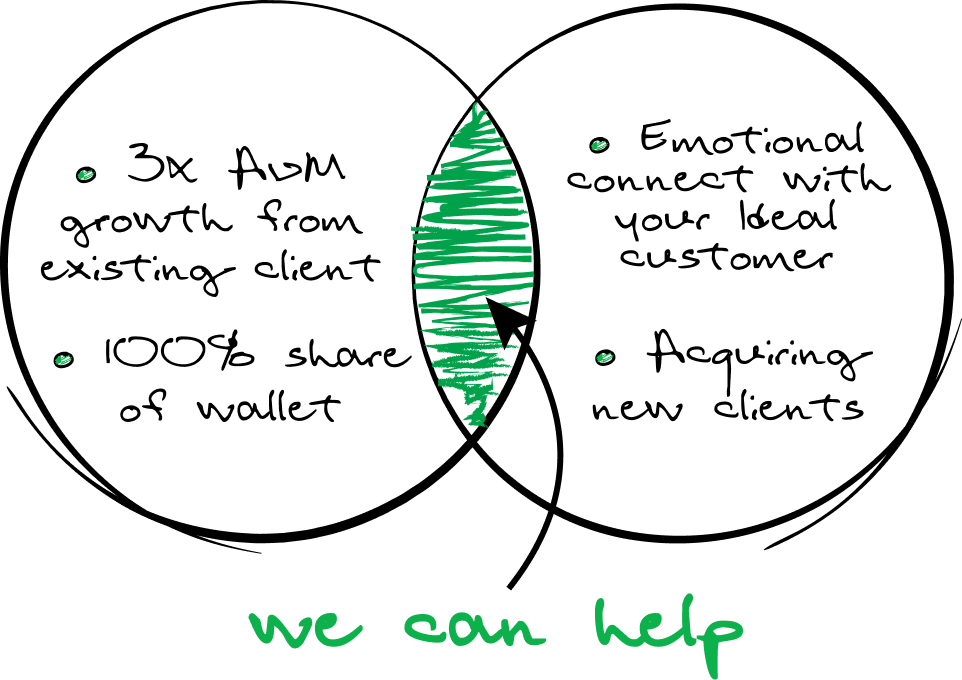
That is why this sketch is so powerful.
Great wealth professionals learn to balance two things.
Empathy on one side.
Facts and figures on the other.
Too much focus on numbers makes your counsel feel cold and mechanical.
Too much focus on emotion without structure creates confusion.
But when the balance is right, something powerful happens.
Clients do not just hear you.
They trust it.
Because they feel understood, and they know the guidance they are receiving is grounded in reality.
In the end, great wealth work is never just about numbers.
And it is never just about emotions.
It is about getting this balance right.
Similar Post
Growth
The Second Objective of your First Prospect Meeting
Imagine your first meeting (the one you have initiated) with a prospect. You have got this meeting after a year of chasing the prospect and you want to close the prospect and add o ....
Read More
25 August, 2020 | 5 Minute Read
Nano Learning
The BH Formula
Let me give you this powerful formula that leads to Success.
Behaviour + Habits = Success
At the same time, I can rewrite this as:
Behaviour + Habits = Lack of Success
Bot ....
Read More
24 June, 2022 | 2 Minute Read
Technology
Investment in Technology versus Digital Transformation
Do the 2 parts in the above headline seem similar to you?
I often see many getting confused between an Investment in Technology and Digital Transformation.
An investment in Techn ....
Read More
24 August, 2021 | 7 Minute Read
Nano Learning
Are you Tapping into this source of Power?
James Clear (Author of Atomic Habits) wrote - "Most people optimize for the day ahead. A few optimize for 1-2 years ahead. Almost nobody optimizes for 3-4 years ahead (or longer).
....
Read More
1 April, 2022 | 2 Minute Read
Marketing
Comparison between 2 Value Propositions
98% of firms and individuals in this industry/profession have the following Value Proposition:
1. Provide Access to Different Products.
2. Identify the best investment or I can Be ....
Read More
19 May, 2020 | 2 Minute Read
Growth
The Constraints that will change your Business and Life
Constraint is a noun and it generally means the state of being restricted or compelled to avoid. We think of constraints as something negative or bad for us. What if I told you oth ....
Read More
1 December, 2020 | 6 Minute Read


- 1
- 1
0 Comments