There is a lot of noise about AI right now.
Some people treat it like a magic wand.
Some treat it like a disease.
Some think it is just another software subscription.
Some believe it will replace them entirely.
And some are quietly experimenting without telling anyone.
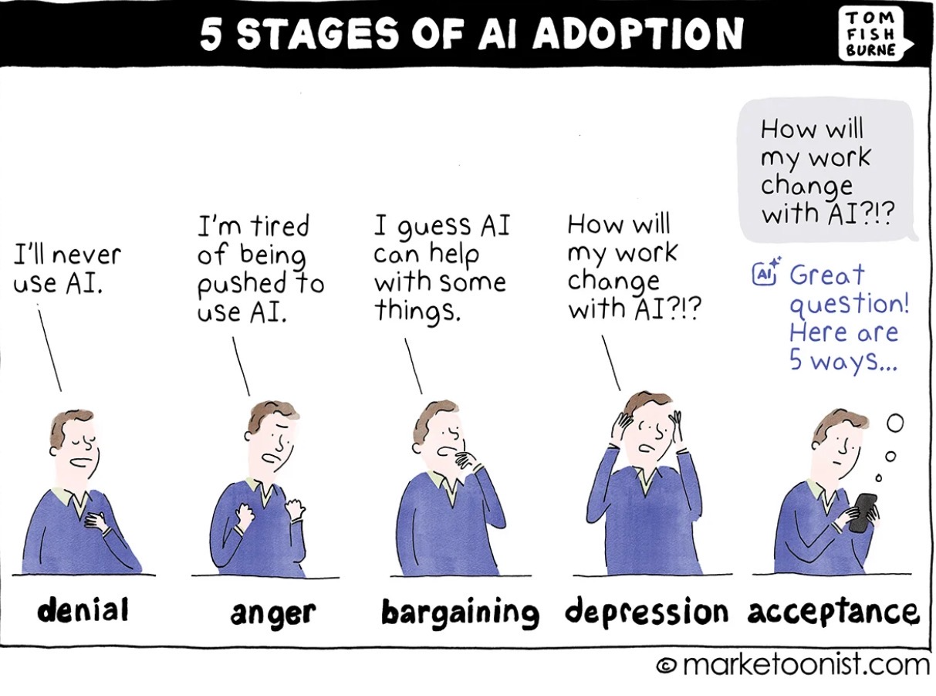
If you observe carefully, the reaction to AI among MFDs follows a very predictable emotional cycle. It looks like the five stages of grief.
Denial.
Anger.
Bargaining.
Depression.
Acceptance.
Let us go through these stages slowly, because where you are right now matters more than you think.
Stage 1: Denial – “I will never use AI.”
This stage is common.
You hear things like, “Our business is relationship driven.”
“Clients want trust, not technology.”
“I have built my practice for 25 years without AI.”
“This is just hype.”
There is truth in some of these statements. The business of wealth is relationship driven. Trust is human. Experience matters.
But denial usually hides something deeper. It hides discomfort.
AI challenges how work gets done. It challenges how information flows. It challenges how quickly answers are expected. It challenges how clients compare you with others.
Ignoring it does not preserve your practice. It simply slows your learning curve.
The MFD who refuses to understand AI is not protecting relationships. He is risking relevance.
Stage 2: Anger – “Why is everyone pushing this on us?”
This stage often follows quickly.
“I am tired of being told to use AI.”
“Every platform is selling AI.”
“Even toothbrushes have AI now.”
“This is marketing nonsense.”
This frustration is understandable.
The industry has turned AI into a buzzword. Platforms throw the word into presentations as if it automatically guarantees growth.
But anger usually means something else. It means you feel pressure. Pressure from competitors. Pressure from clients. Pressure from younger professionals who seem more comfortable with technology.
The danger in this stage is not the emotion. The danger is reacting impulsively.
Some professionals overinvest in tools just to feel modern. Others shut down entirely.
Both reactions are emotional. Neither is strategic.
Stage 3: Bargaining – “Maybe AI can help with a few things.”
This is where maturity begins.
You start thinking more rationally.
“Maybe AI can help me draft communication.”
“Maybe it can help with research.”
“Maybe it can summarize meetings.”
“Maybe it can help my team become more efficient.”
This is a healthy stage.
You are no longer resisting blindly. You are experimenting cautiously.
But there is a subtle trap here.
If you think AI is only about tools, you will use it like a shortcut machine. You will ask it to write posts, generate reports, automate responses, create content. And that is fine. It improves productivity.
But productivity is not transformation.
AI is not just a content assistant. It is a thinking amplifier.
If you only use it to produce more output, you will remain average, just faster.
Stage 4: Depression – “How will my work change? Will I even matter?”
This stage is rarely spoken about openly, but it is very real.
When you see AI models passing exams, analyzing data instantly, generating financial plans in seconds, answering questions faster than you can, it triggers doubt.
“Will clients still need me?”
“What if software replaces my work?”
“What is my value if machines know more than I do?”
This stage forces an important realization.
AI is very good at information.
It is not good at judgment.
It is not good at empathy.
It is not good at holding a client’s hand when markets fall.
It is not good at saying no to a bad decision.
It is not good at building trust over decades.
If your value is only information, then yes, you should be worried.
If your value is interpretation, context, behavior management, financial life strategy, and conviction, then AI is not your enemy. It is your assistant.
Depression ends when clarity begins.
Stage 5: Acceptance – “How will my work change with AI?”
This is the stage of intelligent professionals.
Notice the shift in the question.
It is no longer “Will I use AI?”
It is no longer “Do I like AI?”
It is no longer “Is AI hype?”
It becomes:
“How will my work evolve because of AI?”
This is a strategic question.
In this stage, you stop seeing AI as a threat or a gadget. You see it as infrastructure.
You ask deeper questions:
How can AI free my time from low value tasks so I can deepen client relationships?
How can AI help me prepare better for meetings so my first conversation is sharper?
How can AI help me analyze scenarios faster so I can focus on interpretation?
How can AI help my team standardize processes so client experience improves?
How can AI help me think more clearly?
This is where professionals separate from amateurs.
The future value of an MFD will not lie in access to information. Information is becoming abundant and cheap.
The future value will lie in:
Clarity.
Judgment.
Behavior coaching.
Financial life design.
Communication.
Trust.
Enterprise building.
AI can support all of these. But it cannot replace them.
Let me be very clear.
AI will not replace great MFDs.
It will expose average ones.
If your conversations are shallow, if your differentiation is product driven, if your value is limited to transaction and execution, AI will make you uncomfortable.
But if you are building a world class practice focused on goals, behavior, planning, and deep client understanding,AI becomes leverage.
Think of it this way.
In the past, calculators did not replace accountants. They made good accountants more efficient.
Spreadsheets did not replace analysts. They amplified capable ones.
CRM systems did not replace relationship managers. They structured their work.
AI is similar, but more powerful.
It reduces friction in research.
It enhances communication drafting.
It accelerates scenario analysis.
It improves meeting preparation.
It helps build internal knowledge libraries.
It can simulate client questions.
It can sharpen thinking.
But it cannot replace human responsibility.
There is another important dimension here.
Many platforms talk about AI as a feature.
“We give you AI.”
“We have AI dashboards.”
“We have AI insights.”
That is not enough.
The real question is:
Does the platform help you become wiser with AI?
Does it teach you how to think better?
Does it help you integrate AI into your process?
Does it protect client trust while using technology?
Because AI without philosophy is dangerous.
AI without discipline is noise.
AI without ethics is risk.
AI without human oversight is liability.
The future will not belong to those who adopt AI blindly.
It will belong to those who integrate it intelligently.
Where are you in these five stages?
Denial?
Anger?
Bargaining?
Depression?
Acceptance?
There is no shame in any stage. What matters is movement.
If you stay stuck in denial, you stagnate.
If you remain angry, you react emotionally.
If you bargain without depth, you skim the surface.
If you stay depressed, you underestimate your own value.
If you reach acceptance, you evolve.
And evolution is the true competitive advantage.
AI is not about replacing you.
It is about redefining you.
The MFD of the future will not win because he has the most tools.
He will win because he combines tools with wisdom.
He will use AI to enhance preparation, not replace conversation.
He will use AI to free time for deeper thinking.
He will use AI to strengthen client trust, not weaken it.
The noise will continue.
The hype will continue.
The fear will continue.
But clarity will belong to those who ask the right question.
Not “Should I use AI?”
But “How do I become a better professional in an AI powered world?”









0 Comments