Love Your Clients

Amar Pandit , CFA , CFP 

Amar Pandit
A respected entrepreneur with 25+ years of Experience, Amar Pandit is the Founder of several companies that are making a Happy difference in the lives of people. He is currently the Founder of Happyness Factory, a world-class online investment & goal-based financial planning platform through which he aims to help every Indian family save and invest wisely. He is very passionate about spreading financial literacy and is the author of 4 bestselling books (+ 2 more to release in 2020), 8 Sketch Books, Board Game and 700 + columns.

October 6, 2026 | 16 Minute Read
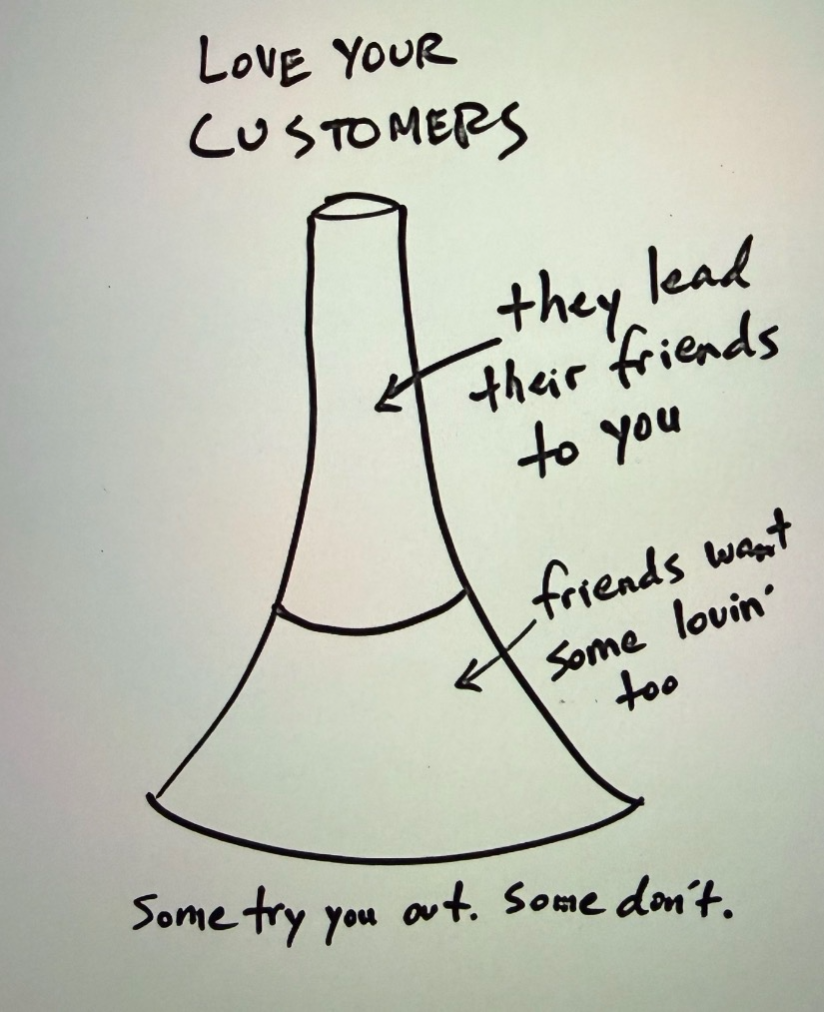
I came across this simple but mind blowing visual recently. It shows what might be one of the most powerful customer acquisition models I have ever seen.
At the top of the funnel are your existing customers.
The instruction is beautifully simple.
Love your customers.
Some of them will love you back…Some of those people will tell their friends about you…Some of those friends will want some of that love too…Some will try you out…Some won’t.
That is, it.
No complicated marketing funnel. No twenty-seven-step lead generation strategy. No obsession with conversion ratios, algorithms, social media followers or the latest marketing technology.
Just do such extraordinary work for the people who have already trusted you that they cannot help talking about you.
When I saw this visual, I immediately thought about our profession.
MFDs spend enormous amounts of time thinking about new client acquisition.
How do I get more prospects?
How do I generate leads?
Should I advertise? Should I do webinars? Should I hire someone for digital marketing?
Should I become active on LinkedIn?
Should I organize investor awareness programs?
Should I start making videos?
These are perfectly reasonable questions, and many of these things can certainly help.
Although I sometimes wonder whether we are asking the second question before properly answering the first.
What experience are we creating for the clients we already have?
The greatest marketing strategy in the wealth business has been sitting inside our businesses all along.
It is called the client… not the client’s assets… not the client’s wallet… not the client’s ability to give us referrals.
The client.
If you love your clients because you want referrals, clients will eventually feel it. The relationship becomes transactional. Every birthday wish, review meeting and invitation quietly carries an expectation behind it.
That isn’t love…That is prospecting wearing a nicer shirt.
The philosophy in this visual works only when the first part is genuine.
Love your clients because serving them exceptionally well is the business you chose to be in.
Understand their families. Understand what they are trying to accomplish. Know what worries them. Know what money means to them. Be there when markets frighten them, but also when life surprises them. Help them make decisions they did not even realize were financial decisions. Do the little things nobody expects.
Then something remarkable begins to happen…They talk.
Think about how you recommend a restaurant to a friend.
You rarely say, “The restaurant has an excellent customer acquisition strategy.”
You say, “You have to go there.”
Why?
Because something about the experience moved you enough to make you want someone you care about to experience it too.
That is the point many businesses miss.
A satisfied client may stay with you. A delighted client may occasionally talk about you. However, a client who feels genuinely cared for becomes something else entirely. He becomes an advocate. Advocacy in financial services is extraordinarily powerful because the greatest obstacle to acquiring a new client is rarely awareness. It is trust. People may discover you through Google, social media, an event or an advertisement, but before they entrust you with the money they have spent thirty years creating, they need to answer a far more important question: Can I trust this person with something that represents my family’s security, my children’s future and perhaps my entire life’s work?
Anyone can advertise. Anyone can build a beautiful website, create an impressive presentation and place photographs of smiling families beside words such as trust, integrity, personalized and client-first. Saying you are trustworthy and being trusted are two very different things. Trust cannot be manufactured by marketing because trust is accumulated through experience. It is built slowly, conversation by conversation, decision by decision, especially during those moments when doing what is right for the client may not necessarily be what is most profitable for you.
You cannot manufacture twenty years of trust overnight. A client who has experienced those twenty years can transfer some of that trust to you in a single sentence: “You should speak to my financial professional.”
Think about the extraordinary power of those seven words. The person receiving that recommendation is no longer meeting you as a stranger. He arrives carrying a little of the confidence his friend already has in you. He may still evaluate you, question you and ultimately decide not to work with you, but he is not beginning at zero. He is borrowing trust from somebody he already trusts. That is why a referral from a deeply cared-for client is fundamentally different from an ordinary lead. A lead gives you an opportunity to earn trust. An advocate lends you some of theirs before you have even entered the room.
That is also why the best client acquisition strategy cannot really begin with client acquisition at all. It must begin with creating relationships so meaningful, experiences so thoughtful and care so genuine that clients naturally want the people they love to experience the same thing. The most powerful referral is not the one you ask for. It is the one your client feels compelled to give. When that begins happening consistently, you haven’t merely created a marketing engine. You have created something far more valuable: a business whose reputation travels ahead of it.
That is why a referral from a deeply satisfied client is fundamentally different from an ordinary lead.
A lead knows your name… A referred prospect arrives carrying context.
They may already know how you behaved during a difficult market. They may know how you helped their friend through retirement. They may know that you guided the client not to make an investment when everyone else was chasing it. They may know that you helped organize a financial life that had become unnecessarily complicated.
Sometimes they know your value before they have even met you… That is an extraordinary advantage.
This is where I believe MFDs need to go much deeper. You cannot manufacture advocacy simply by asking clients for more referrals. You create it by becoming more referable. Those may sound like two versions of the same strategy, but they are fundamentally different. Asking for referrals begins with the question, what can my client do to help me grow? Becoming referable begins with a very different question: What can I do so extraordinarily well for my client that talking about me becomes almost inevitable? One is built around extracting more value from the relationship. The other is built around creating more value within it. I know which one I would rather build a business around.
Imagine an MFD serving 300 families. For years, most of his growth efforts may have been directed outside those 300 relationships. He attends events, collects numbers, follows up with prospects, runs marketing campaigns and occasionally asks existing clients for introductions. There is absolutely nothing wrong with any of this. What if he looked at those same 300 families and asked himself a completely different question: “How can I make the experience of these 300 families so extraordinary that talking about us becomes natural?” This single question changes the lens through which you see the entire business. Your existing clients stop looking like relationships you have already acquired and start looking like relationships you have barely begun to deepen.
Suddenly, a review meeting is no longer an exercise in showing performance. It becomes a conversation about the client’s life. An annual call is no longer merely about SIPs and portfolios, but about discovering what has changed in the family since you last spoke. When a client’s daughter goes abroad to study, you know about it. When retirement is approaching, the conversation begins years before the retirement party. When markets fall sharply, the client does not have to wonder whether he should call you because you have already called him. And when something happens to the primary financial decision-maker, the spouse is not left staring helplessly at a cupboard full of statements, passwords and investments because there is already someone who understands the family’s financial life and knows exactly what needs to happen next.
Even the investment conversations begin to change. When a client asks whether he should buy whatever fashionable investment everyone is discussing, your first instinct is no longer to search for a product. You become curious about why he is asking. Is it greed? Fear of missing out? Something a friend said? Anxiety that his existing portfolio is not doing enough? The question may sound like it is about an investment, but very often the real opportunity is to understand the human being asking it. That is what genuine financial care looks like. It is not merely knowing what your client owns. It is knowing what is happening in the life that those investments are supposed to serve.
None of this may appear on an AUM report. There is no column in your MIS called “peace of mind created, family understood, panic prevented or spouse protected.” These things show up somewhere far more powerful. They show up in conversations at dinner tables. They show up when a friend complains about his financial professional and your client quietly says, “You should speak to mine.” They show up when somebody asks your client why he seems so relaxed despite markets falling and he says, “My financial professional has already spoken to me. We have a plan.” That is when you realize that the most powerful marketing your firm will ever do is not what you say about yourself. It is what your clients say about you when you are not in the room.
A few more real conversations:
“My father passed away and these people handled everything.”
“I was going to make this investment, but he actually told me not to.”
“They know my family and they are there for us.”
“I don’t have to worry about money anymore.”
This is marketing of the most powerful kind.
Nobody has been paid to say it.
There is another beautiful part of this visual that is easy to overlook: some don’t. Some friends will hear wonderful things about you and still never call. Some will meet you and decide you are not right for them. Some will choose another financial professional, while others will continue managing things themselves. This is perfectly fine. One of the most liberating things a business can understand is that it does not need everyone. You don’t need every prospect to become a client. You need the right people to understand what you stand for, believe in the way you work and value the kind of relationship you are trying to build.
There is a subtle danger in becoming obsessed with conversion. Eventually, we begin designing the business around getting more people to say yes rather than creating something genuinely worthy of being said yes to. The first makes us better at persuasion, follow-ups, funnels and sales techniques. The second forces us to become better at what we do. It makes us ask whether the experience is extraordinary, whether the guidance is thoughtful, whether the care is genuine and whether clients are better off because we are in their lives. One creates a better sales machine. The other creates a better business. Over decades, I know which one compounds.
This matters enormously in financial services because ours is not a one-time transaction. We are not selling someone a pair of shoes and hoping they return next season. At its best, a financial relationship can last twenty, thirty or forty years, sometimes travelling across generations. Think about the extraordinary possibilities contained within one deeply cared-for family. Over time, that relationship may extend naturally to children, siblings, parents, business partners, colleagues and friends. One family can quietly become the beginning of many meaningful relationships over a decade or two. That happens only when the original relationship is good enough to travel.
This is why I believe that the word “referral” does not fully capture what is happening. A referral sounds like a lead-generation event, something to be entered into a CRM and moved through a sales funnel. What is really taking place is the transmission of reputation? When a client tells a close friend, “You should speak to my financial professional,” he is not merely giving you a prospect. He is putting a small piece of his own reputation into your hands. He is effectively saying, “I trust these people enough to attach my name to them.” That is an extraordinary compliment, but it is also an extraordinary responsibility.
If you disappoint that friend, you haven’t merely disappointed a prospect. You have made your client look bad. He took a social risk by recommending you, and your behavior now reflects partly on his judgement. That is why every introduction should be treated with enormous respect. Your client has not merely given you a lead. He has lent you his trust, his credibility and, for a moment, a little piece of his reputation. Your job is to honor all three.
When you honor that trust repeatedly, one client tells another, who tells another, who eventually introduces another family. This is not because you created a clever referral program, but because your reputation has begun travelling through relationships that already contain trust. At that point, growth stops being something you are constantly trying to manufacture and begins becoming the natural consequence of the way you treat people. That is when a business develops something far more powerful than a sales funnel. It develops a reputation that compounds.
Growth starts becoming an outcome rather than an activity. Yes, businesses still need strategy, visibility, communication and deliberate growth initiatives.
The engine underneath the business then begins to change. You are no longer constantly pushing strangers through a funnel, trying to convert attention into leads and leads into clients. Something far more powerful begins happening. Your existing clients start pulling people towards you. That is a fundamentally stronger force because people are not arriving because an advertisement persuaded them to come. They are arriving because someone they already trust has given them a reason to trust you.
This is also why I believe client experience and marketing can no longer be thought of as two separate functions. We may have a marketing team, an operations team and a wealth team, but the client sees none of those departments. The client sees one firm. The speed with which you respond when something goes wrong is marketing. The warmth with which somebody is greeted when they enter your office is marketing. The quality of your review meeting is marketing. The way you behave when markets fall sharply is marketing. The guidance you give when there is absolutely nothing for you to earn from it is marketing. Even the call you make when there is no transaction to discuss is marketing. In the end, perhaps the most important piece of marketing your firm will ever create is the sentence a client says about you when you are not in the room. That is the one piece of marketing you cannot script. You must earn it.
This brings me to something particularly relevant for MFDs. For years, our industry has largely measured the economic importance of a relationship through AUM. A Rs.10 crore client is obviously more valuable economically than a Rs. 1 crore client. Reputation however introduces another dimension of value that does not appear neatly in an AUM report. A client who feels extraordinarily cared for may eventually contribute far more to the growth of your business than his current assets suggest, because clients do not exist in isolation. They have families, friends, colleagues, business partners and communities. Most importantly, they have stories, and stories travel much further than performance presentations.
Nobody goes to a dinner party and says, “My MFD has a robust six-stage fund-selection framework.” On the other hand, someone might say, “You won’t believe what my financial professional did for us when my father passed away,” or “Markets were collapsing and he called me before I even thought of calling him,” or simply, “These people really know my family.”
That sentence is gold because it contains something no brochure can manufacture – lived experience. You cannot buy it, advertise your way into it or instruct clients to say it. You must create an experience worth telling someone else about.
This is precisely where scale becomes interesting. As businesses grow, founders naturally build teams, technology, processes and systems. They must. There is a danger hidden inside that progress: efficiency can quietly replace intimacy. The client who once felt known begins to feel processed. Calls become tickets, conversations become templates, review meetings become presentations and personal knowledge slowly disappears into CRM fields. The organization becomes more sophisticated while the relationship becomes less personal. The business becomes larger while the relationship becomes smaller. For a financial business built on trust, that is a dangerous trade.
Technology should help us remember more, not care less. Processes should help us deliver consistently, not make every client feel identical. Data should help us understand people more deeply, while AI should give our financial professionals more time to do the deeply human work only they can do. This is because underneath all the technology, dashboards and processes lie one requirement that cannot be automated away: somewhere in the relationship, another human being must genuinely feel that somebody cares about what happens to them. That is ultimately the business we are in. Money simply happens to be the medium through which we practice that care.
There is a powerful strategic lesson here as well. Businesses spend enormous amounts of money and management attention trying to reduce the cost of acquiring the next customer. We should rather spend just as much energy increasing the quality of the experience of the customer we already have, because the two may be far more connected than we realize. The more extraordinary the existing client experience becomes, the less aggressively the business may need to chase strangers. Your happiest clients begin doing something no advertisement can ever do as convincingly: they provide evidence. This is not evidence that you can predict markets or generate the highest returns, but something much more valuable in financial services. Evidence that you can be trusted.
Trust compounds. One client tells another. That person experiences the relationship and eventually tells somebody else. Years pass, the network expands and the reputation deepens. Eventually, prospects begin walking through your door and saying perhaps the most beautiful sentence any financial professional can hear: “Three people told me I should meet you.” At that point, you have built something far more valuable than a successful marketing campaign. You have built gravity. People are being pulled towards the business by the experiences of the people already inside it.
That is why I find this crude little hand-drawn funnel so profound. It turns the conventional acquisition funnel almost completely upside down. The traditional funnel begins with strangers and asks how we can move them towards becoming customers. This one begins with customers and asks how deeply we can serve them. The traditional funnel begins with attention and tries to manufacture conversion. This one begins with care and allows advocacy to emerge as a consequence. Instead of endlessly asking, “How do we acquire more people?”, it asks a far more powerful question: “Are we doing work worth talking about?”
Every MFD should sit with that question for some time. If clients are not talking about us, the answer may not always be that we need better marketing. We rather need a better client experience. Our conversations need to go deeper, from folios to families and from products to lives. We need to solve problems clients did not even realize we could solve or become more present during the moments that truly matter. Most importantly, we need to stop thinking of existing clients as people we have already acquired. A client may have chosen you twenty years ago, but his trust is something you continue earning every single day.
I believe the finest financial businesses of the future will understand this deeply. They will certainly use technology, sophisticated processes, analytics, content, branding, marketing and AI. However underneath all that sophistication will sit something surprisingly old-fashioned: care. When people genuinely feel cared for, they remember. When they remember, they talk. When they talk, other people become curious. And when those people experience the same care, the circle begins again.
We have made customer acquisition far more complicated than it needs to be. The most powerful way to acquire the next client has always been to love the one you already have.
Love your clients.
Love them through your attention, your competence, your honesty, your processes and your presence when things become difficult. Give them an experience they did not know a financial professional could provide.
Some will love you back… Some will tell their friends… Some of those friends will come to you… Some won’t.
That is okay because the objective was never to make everybody your client.
The objective was to become the kind of financial professional your best clients cannot help talking about.

Similar Post
Featured
The Only Metric That Matters
Amar Pandit , CFA , CFP
Many financial professionals are caught in the same trap that business owners fall into. The illusion that analyzing endless streams of data will somehow unlock the secret to succe ....
Read More
16 September, 2025 | 7 Minute Read
Featured
The Founders Dilemma: Navigating Time Traps
Amar Pandit , CFA , CFP
Last week, I hosted an Ask Me Anything session called “Ask Amar”. While I answered many questions on growth, marketing, strategy, first meetings, succession, valuation and so o ....
Read More
20 February, 2024 | 6 Minute Read
Featured
Rs.1000 Crore Versus Rs.500 Crore
Amar Pandit , CFA , CFP
Let me begin this post with an interesting question that I asked a few distributors.
“Imagine there are two firms in the distribution space... One (Firm A) with Rs.1000 Crore of ....
Read More
31 October, 2023 | 5 Minute Read
Featured
The Dad Lesson
Amar Pandit , CFA , CFP
This post is dedicated to my father “Prabhakar D. Pandit”, the real hero of my life. He departed for his heavenly abode last night (2nd October 2022) at the age of 82 (well he ....
Read More
4 October, 2022 | 5 Minute Read
Featured
The Invisible Balance Sheet
Amar Pandit , CFA , CFP
A few months ago, I had an interesting conversation with a large private equity fund that had reached out through an intermediary. They were keen to explore an investment in Happyn ....
Read More
25 August, 2026 | 8 Minute Read
Featured
Rising Above Impostor Syndrome
Amar Pandit , CFA , CFP
For a long time, I've wrestled with the idea of discussing Impostor Syndrome. There's always been that whisper of doubt: will it resonate, or will it fall on indifferent ears? Yet, ....
Read More
30 April, 2024 | 5 Minute Read


- 0
- 0


0 Comments