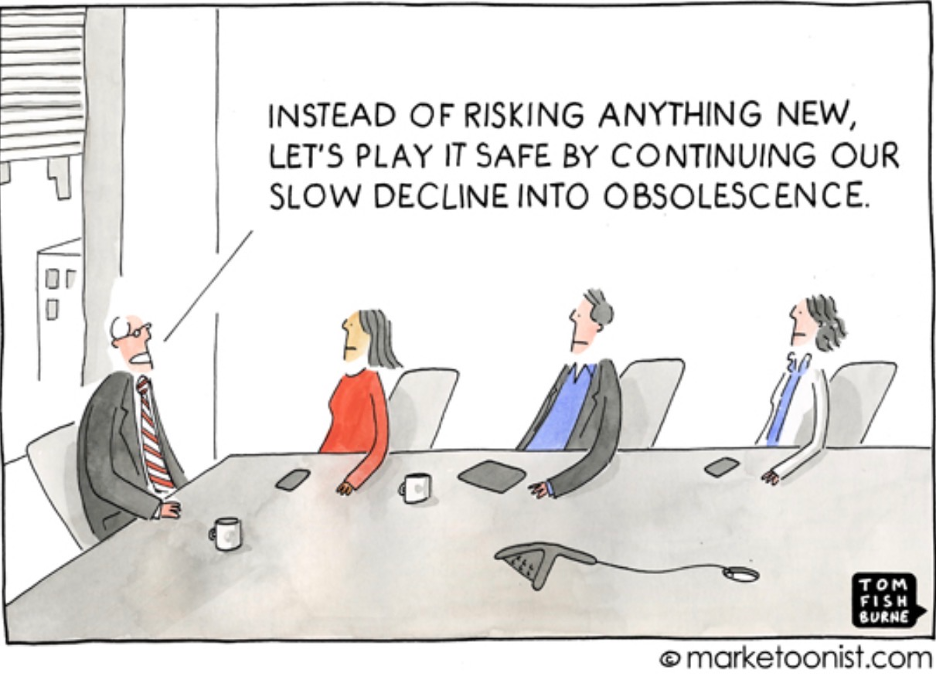
I came across this insightful cartoon recently. I immediately started writing a post because it perfectly describes what happens to many wealth businesses.
Not overnight.
Not dramatically.
Not because of a crisis.
But slowly almost invisibly.
Let me share the story of Prakash, a successful MFD based out of a metro city.
He managed around Rs. 600 Crore of assets.
His clients trusted him.
His revenues were healthy.
His business had been growing steadily for years.
On the surface, everything looked fine.
In fact, whenever anyone asked him how things were going, he would smile and say, “All is well.”
And he genuinely believed it.
One day, a younger financial professional asked him an interesting question.
“Prakashji, what are you doing to prepare your business for the next ten years?”
Prakash said, “Why fix something that isn’t broken?”
The young professional smiled.
That answer would come back to haunt him.
A few months later, someone showed Prakash a new client experience platform.
“It looks interesting,” he said.
“But let’s wait and watch.”
A year later, somebody spoke to him about building a team.
“Not now. Things are manageable.”
Another year passed.
Someone suggested documenting processes.
“Clients know me personally. Why do I need that?”
Then came succession planning.
“Still have time.”
Then branding.
Then technology.
Then collaboration.
Then hiring.
Then creating a differentiated client experience.
Every time, the answer was the same.
“Let’s wait.”
Prakash thought he was being prudent.
He thought he was avoiding risk.
He thought he was playing safe.
What he didn’t realize was that he was making the riskiest decision of all.
Doing nothing.
The strange thing about business is that standing still is impossible.
You are either moving forward or moving backward.
There is no third option.
The world changes whether you choose to change or not.
Client expectations change.
Technology changes.
Competition changes.
Valuations change.
Talent changes.
Consumer behavior changes.
The definition of excellence changes.
And while all of this was happening, Prakash was standing still.
Five years later, something interesting happened.
His business was still there.
His clients were still there.
His revenues were still there.
Which made him believe he had been right all along.
But something else was happening beneath the surface.
Growth had slowed.
New client acquisition had become harder. A few of the top clients were taken by a bigger wealth firm.
Younger clients seemed less engaged.
His team struggled with basic operational tasks.
His valuation wasn’t growing.
His energy levels were declining.
And competitors were starting to look very different.
Prakash did not see a problem because decline rarely arrives with a warning sign.
It arrives quietly.
One small compromise at a time.
One postponed decision at a time.
One year at a time.
That is what makes it dangerous.
Most people imagine risk as something dramatic.
Launching a new initiative.
Hiring a senior person.
Investing in technology.
Partnering with a platform.
Opening a new office.
Building a new capability.
Those feel risky because they involve action.
But there is another kind of risk.
The risk of becoming irrelevant.
The risk of becoming ordinary.
The risk of becoming replaceable.
The risk of waking up one day and discovering that the world has moved ahead while you stayed exactly where you were.
And this risk is far more dangerous because it feels comfortable.
Nobody wakes up and says, “Today I will become obsolete.”
Instead, they say: Let’s wait. Let’s see. Maybe next year. Things are fine right now.
Sound familiar?
Blackberry thought they were playing safe.
Nokia thought they were playing safe.
Thousands of businesses throughout history thought they were playing safe.
Most of them disappeared.
Not because they made a catastrophic mistake.
But because they failed to evolve.
The danger for financial professionals is exactly the same.
Many are still operating their firms exactly the way they did ten or fifteen years ago.
The industry has changed.
Clients have changed.
Technology has changed.
Yet their businesses haven’t.
They still depend entirely on themselves.
They still have undocumented processes.
They still struggle to attract talent.
They still view client experience through yesterday’s lens.
They still postpone important decisions and they call this being conservative.
It isn’t.
It is simply a slow decline that hasn’t become visible yet.
One day Prakash met a financial professional, Atul, who had joined a larger platform.
Atul was younger.
His business was smaller but his growth was explosive.
His clients received a world-class experience.
His team was expanding.
His processes were scalable.
His valuation was increasing.
And perhaps most importantly, he had time.
Time to think.
Time to innovate.
Time to focus on growth.
Prakash asked him a simple question.
“What changed?”
Atul replied, “I stopped asking how to protect what I had. I started asking what I needed to become.”
That answer hit Prakash in some way.
Because that is the real question.
Not how do I protect my business.
But what does my business need to become?
An enduring business is not built by protecting the past; It is built by creating the future.
Every meaningful improvement initially feels uncomfortable.
Every worthwhile investment feels expensive.
Every significant change feels risky.
Until it becomes obvious.
And by then, the leaders have already moved.
The followers are still discussing whether they should.
The most successful professionals I know are not reckless.
They are thoughtful but they understand one thing.
The future belongs to those who are willing to build it and not those who are waiting to see what happens.
The irony is that most financial professionals spend years worrying about the risk of change.
Very few spend time worrying about the risk of staying the same.
Yet one of those risks is temporary.
The other can be permanent.
Let me give you a question to reflect on.
Five years from now, when you look back at your business, what will be your biggest regret?
The changes you made or the changes you kept postponing?
Because the biggest threat to your business may not be competition.
It may not be regulation.
It may not be technology.
It may simply be the comforting belief that doing nothing is the safest option.
As the cartoon brilliantly reminds us:
“Instead of risking anything new, let’s play it safe by continuing our slow decline into obsolescence.”
The question is simple.
Are you building the future or are you slowly protecting the past?








0 Comments